
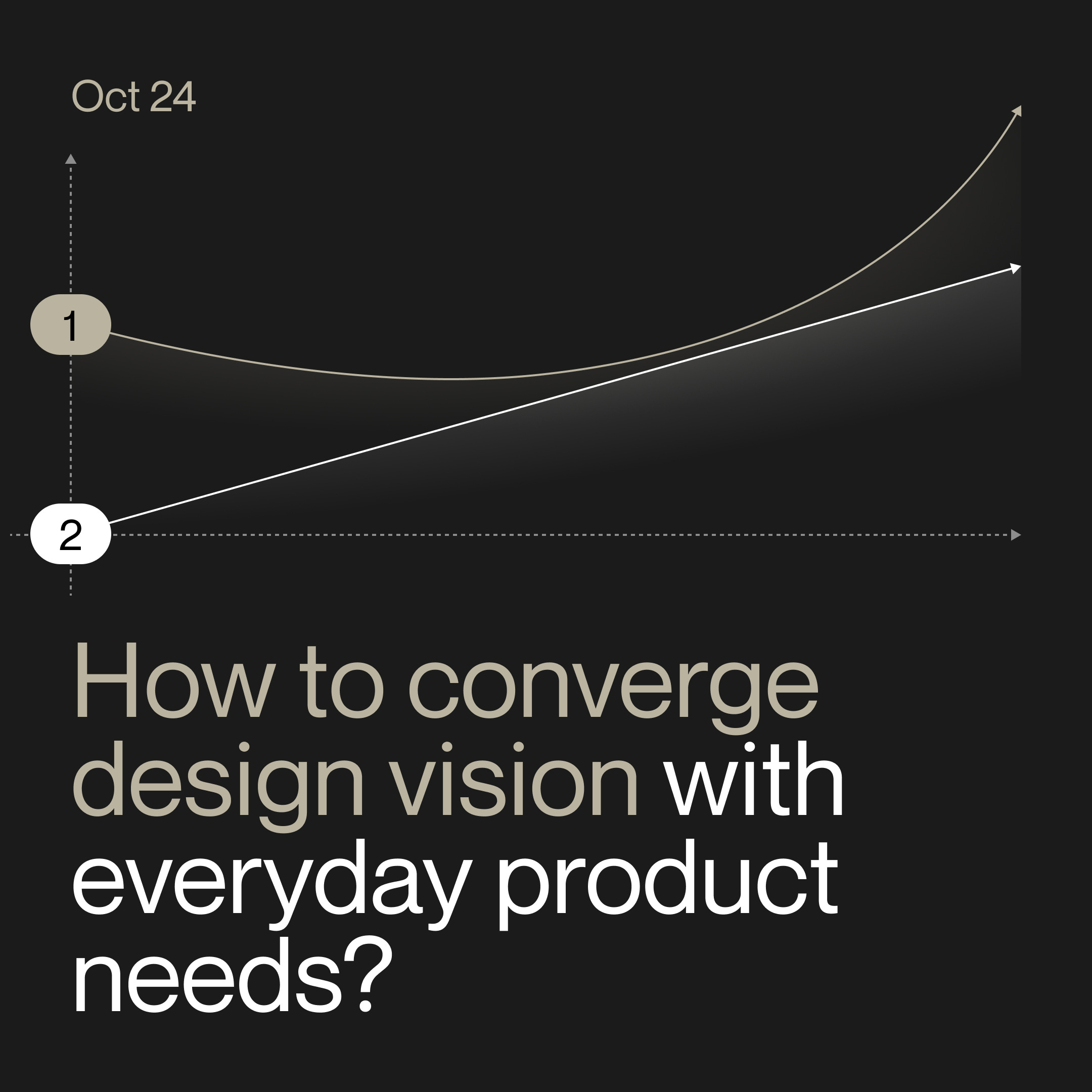
Having spent several years navigating the intersection of design vision and product incremental needs, I've come to see two distinct but interconnected Lines of product design work:
Line 1 is the vision work progression.
This Line represents the product's future direction, driven by vision, strategy, and data. While grounded in research, visionary work requires bold, cutting-edge thinking. Early ideation thrives on creativity, where experimentation and calculated risk-taking fuel innovation. This Line propels products and brands forward, often with geometric impact—positive or negative. Though harder to measure due to its subjective nature, success becomes evident through the creation of elevated, standout products and companies when executed well.
Line 2 is the underlying and incremental progression.
This Line focuses on optimization—enhancing existing products and brand experiences through informed, systematic effort. It's a continuous listening, testing, researching, and iterating process, which is essential for progress. Teams primarily work in this space, as it's a core function for most companies. While this work can be resource-intensive, it's easier to measure success thanks to accessible data and research tools. Unlike Line 1, this process begins and ends with tangible results, making performance comparisons more straightforward.
Here are my learnings about the 2 Lines of work and their relationships:
Fragmenting teams and isolating feature teams from vision disconnects the two Lines of work and drives both to failure.
A transparent and constant sharing of vision is crucial to helping teams meet their everyday needs.
Allow feature teams and squads to participate in the vision work. Bring them to work sessions, embed members in the vision work for sprints, leverage their knowledge, and make decisions with those in mind.
Know when to work together and when to divide and conquer. Find moments when each team needs to split and get work executed. It takes sensibility and seniority to drive this change, which varies dramatically from company to company.
Learn how to read data and research but, most importantly, follow the team's creative directions and insights. We are designers, product managers, data analysts, and engineers with years of experience. Sometimes, our knowledge gives us a much better direction than any data. Sometimes, research can be misleading, and users might say "no" to something they will learn to use and love in the future. How many Blackberry users might have told on research that a physical keyboard was mandatory for the future of "smart" mobile devices?
Acknowledge the working profiles of people more suitable to work in each Line. We are complex individuals with various skill sets and goals, and that's brilliant. Team building plays an important role here: make sure people collaborate and respect each other's skill sets without overshadowing each other or overvaluing their areas of expertise.
When Line 2 gets close to Line 1 (we get closer to the vision once set), it is a good time to inject efforts into raising Line 1 even more. They should never meet if the company seeks innovation.
Adapt Line 1 to meet Line 2 when necessary. It's okay to step down the vision to allow more innovative launches. A good example is adapting the vision design to utilize existing Design System components. At the same time, the Design System team works on building the next version of their component set. It will create the urgency to step up shortly.
Set the vision and work on the optimization. Have feature teams get closer to the vision Line. Raise the vision Line. Repeat.
This post is supposed to be a conversation starter. Working those Lines is not always straightforward; it's filled with nuance and intricacy, which can lead to challenges. However, when we strike the right balance, it can be rewarding for all involved.